
Lil Bit Brit Lit Has Moved To Wordpress

https://lilbitbritlit.wordpress.com/

About Me

My photo
An English girl living in Penn's Woods. I live in an old Dutch style colonial house, with my husband Mr Bit Brit, our son Rob, and our two cats Tinkerbell and Tuppence. E-Mail: lilbitbrit_007@msn.com
Showing posts with label Historic. Show all posts

Wednesday, October 16, 2013

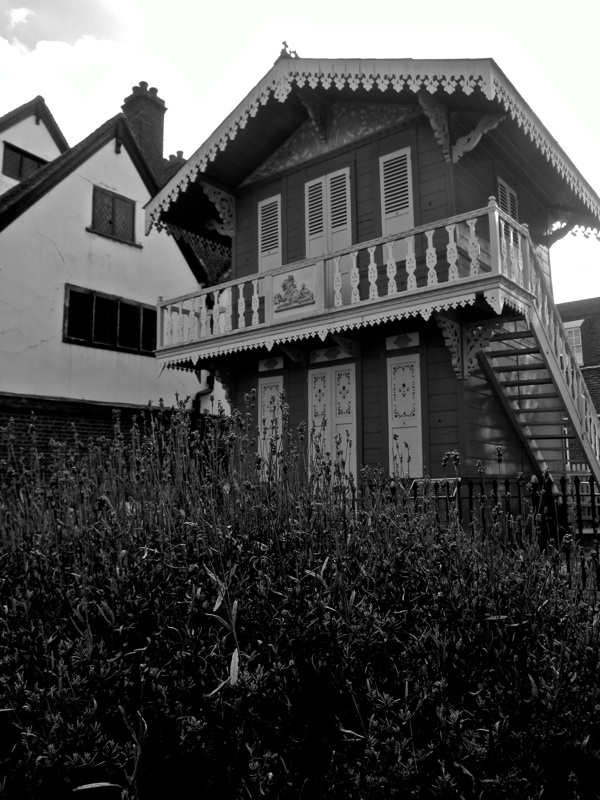
Charles Dickens Writing Chalet Rochester

The chalet was a gift from his friend, Charles Fechter (1824–79) in 1864, and Dickens used it as a summer study for the rest of his life. Indeed, it was in the upper room of the chalet that he wrote his last words on the afternoon of 8th June, 1870.


To Begin With Charles John Huffam Dickens was born at 13 Mile End Terrace, Portsmouth (now the Dickens Birthplace Museum) on Friday, 7th February, 1812. His father, John, was a clerk in the naval pay office, and Charles’s early years were spent moving whenever and wherever his father’s postings dictated. In January 1815, John was transferred to London, and the young Dickens first encountered the city with which his later life and fiction would become so indelibly linked. Two years later, the family moved to Chatham in Kent where Charles enjoyed the happiest years of his childhood. His mother taught him the rudiments of reading, and he received an education courtesy of a schoolmaster named William Giles. Charles also enjoyed long walks through the Kent countryside with his father.

Life in London Dickens’s childhood idyll ended abruptly in 1822 when John Dickens was transferred back to London and his income reduced severely. John, a man who was never able to live within his means, plunged heavily into debt. His wife, Elizabeth, attempted to alleviate the family’s financial predicament by opening a school for young ladies, but that failed and, in 1824, John Dickens was arrested for debt, and incarcerated in the Marshalsea Prison. Elizabeth and the younger children went with him. However, the sensitive Charles was sent to begin work at Warren’s Blacking Factory.

The young boy, who had truly believed he was destined to be a gentleman, now found himself sticking labels onto pots of boot blacking. His misery was exacerbated by the fact that his beloved elder sister, Fanny, had been enrolled at the Royal College of Music. Charles longed to resume his education, but left to his own devices, he roamed the streets of the capital, where he mixed with the low life of early 19th-century London, taking in everything he saw.

John Dickens was released from prison after 14 weeks, as his mother-in-law had died and left him a little money. But he was still not out of debt. However, in 1825, he took Charles away from the blacking factory, and despite vociferous objections from Elizabeth, who wanted their son to continue bringing in a useful weekly wage, John sent him to school at Wellington House Academy. Charles never forgave his mother.

Dickens stayed at the Academy for about two years, before his father’s debts forced him back into employment, this time for Ellis and Blackmore, a firm of solicitors in London’s Gray’s Inn. Whilst there, he learned shorthand, and after 18 months felt confident enough to establish himself as a shorthand writer at Doctors’ Commons, near St Paul’s Cathedral in the City. By 1830 he had met and fallen madly in love with a banker’s daughter named Maria Beadnell. A year later he began work as a reporter for his uncle’s newspaper The Mirror of Parliament. In 1832, he applied for, and was granted, an audition at the Covent Garden Theatre, but on the day in question illness prevented him from attending. Dickens’s love of the theatre and desire to perform remained with him for the rest of his life and resulted in his amateur theatricals and later his public reading tours.

Dickens’s career as writer takes off.  By May 1833, Maria’s ardour had cooled considerably and their relationship ended. In an attempt to overcome his broken heart Dickens flung himself into his writing, and at the end of the year his first story A Dinner at Poplar Walk was published. By 1834 he was working for the Morning Chronicle newspaper and became friends with its music critic, George Hogarth. In 1835 Hogarth became editor of the Evening Chronicle, and he invited Dickens to contribute sketches to the paper. These would eventually appear in print as Sketches by ‘Boz’. Dickens had also fallen in love with Hogarth’s daughter, Catherine, and on 2nd April, 1836 the two were married at St Luke’s Church, Chelsea. Following a honeymoon in Kent, they settled into chambers in Furnival’s Inn, Holborn. By this time the first instalment of Pickwick Papers had appeared, despite the suicide of its originator and illustrator Robert Seymour. Hablot Browne, who for the next 20 years remained Dickens’s chief illustrator, replaced Seymour, and when Dickens introduced the character of Sam Weller, Pickwick Papers became a publishing phenomenon. In December 1836, Dickens met John Forster, who at the time was the literary and drama editor of The Examiner. The two became firm friends, and Forster effectively became Dickens’s agent for the rest of his life and, following the author’s death, his primary biographer. The Death That Devastated Dickens In January 1837, Charles and Catherine’s first child, also named Charles, was born, and by April the family had moved to a house in Doughty Street more suited to both Dickens’s growing family and reputation. Catherine’s younger sister, Mary, moved in with them, and Dickens developed an intense platonic relationship with her. Then, on 6th May, 1837, Mary died suddenly at their house, leaving Dickens utterly devastated by the loss.

His Success Increases. Over the next few years while living at Doughty Street, Dickens cemented his reputation with Oliver Twist (1837–38), Nicholas Nickleby (1838–39), and began work on Barnaby Rudge (1841). His family also increased with two daughters, Mary and Kate, born in 1838 and 1839. By 1839 Dickens’s growing fame enabled them to move to a grander house at 1 Devonshire Terrace, Marylebone. Their fourth child, Walter, was born in 1841, and in January 1842, Charles and Catherine set off on a six-month tour of America. Such was his fame now that Dickens found himself mobbed on several occasions. Back in London he wrote Martin Chuzzlewit (1843–44) and, a year later, what is perhaps one of his best known works, A Christmas Carol (1843).

A Mid-Life- Crisis By 1855, with his family swollen to ten children, one of which, Dora, had died in infancy, Dickens was becoming restless. In February, he received a letter from Maria Beadnell, now Mrs Winter. He replied enthusiastically, pouring scorn on her assertion that she was now toothless, fat and middle aged. ‘You are always the same in my remembrance’ he wrote. They planned to meet at his house when his wife was ‘not at home’, but Dickens was shattered to find that Maria was exactly as she had described herself. His passion cooled and he, rather cruelly, portrayed her in Little Dorrit (1855–57) as Flora Finching, once pretty and enchanting, but now fat, diffuse and silly.

Dickens Buys The House Of His Dreams. In 1856, he purchased Gad’s Hill Place in Kent, a house he had first seen whilst walking with his father in the idyllic years of his childhood. In January 1857, he directed and acted in Wilkie Collins’s play The Frozen Deep and as he researched professional actresses to play the female parts, he met the young actress Ellen Lawless Ternan who became his intimate friend and probably his lover. The following year Dickens formally separated from his wife, and viciously attacked her in an article published in several newspapers. His daughter Kate later recalled, ‘My father was like a madman… He did not care a damn what happened to any of us. Nothing could surpass the misery and unhappiness of our house.’ His younger sister-in-law, Georgina Hogarth, became his housekeeper, and rumours began to circulate that it was his affair with her that had caused his marital breakdown.

Public Readings and Secret Lives. In August 1858, Dickens began the first of a series of reading tours that would, over the next 12 years, prove extremely profitable. By 1860 Gad’s Hill became his permanent residence. Over the next ten years, as he and Ellen Ternan became more involved with each other, his personal life became more and more enigmatic. It is possible that he took a house in France for Ellen and her mother, where he visited them frequently. However, Dickens’s secret life came close to exposure in 1865 when he, Ellen and her mother, were travelling back from France and their train was involved in a serious accident at Staplehurst in Kent. Although Dickens tended to the injured and dying, he refused to attend the subsequent inquest probably for fear it would make public the fact he was travelling with Ellen Ternan.

The Death of Dickens Over the next few years, Dickens undertook several private reading tours in England and America. But his health was failing and by 1870 he looked considerably older than his 58 years. Then on the 8th June, 1870, having spent the day working on what was to be his last unfinished novel The Mystery of Edwin Drood, he collapsed at the dinner table and died the next evening.

Friday, April 5, 2013

***** The Village by Marghanita Laski

The Village by Marghanita Laski is a special read.  She is fast becoming one of my favourite authors.

Wendy Trevor and Edith Wilson on duty at the Red Cross post as usual, it is the very last day of World War II.  They are sharing intimacies of their life's that they would never dreamed of sharing together before the war.  As Wendy Trevor lives at the top of the hill and is considered middle class and Edith Wilson lives at the bottom of the hill and is considered working class.

"There's a lot of us will miss it, "  Edith said  "We're all of us felt at times, you know, how nice it was, like you and me being able to be together and friendly, just as if we were the same sort, if you know what I mean."

They talk about their families, Wendy has two children Sheila and Margaret, Edith has three children, Edie, Maureen and Roy.  They confide that they both lost a child in death, Wendy when her and the Major farmed for a while in Kenya and lost a little boy and Edith confides that she had a little girl who died.  They have become very close.

The Trevor's returned from Kenya before they lost all their money and bought an old house with a small holding chicken farm, their income is about six pounds per week.  Edith confides that when her Roy comes back from the war he will pick up his old job as a printer, his apprenticeship having been finished and he will make ten pounds per week.  Edith used to be Wendy's day lady, cleaning and cooking for her, but since they had to use all her income on the private schooling of their girls, there is just no money for a daily.  The Major is a disaster at business, being born in the era when landed gentry did not have to work and their private incomes where never going to end, but of course all this changed.

"Then they parted, Mrs Trevor going up the road to Wood View on Priory Hill where the gentry lived and Mrs Wilson going downhill on the other side, down Station Road among the working class."

Wendy dispares of her eldest daughter.

"She looked at Margaret ... her soft brown hair caught back with a slide from her sweet but oh, so uninteresting face. ... thoughts of contrast between the life she had once known and the one she was living now."

If her sister had lived and not died in the car accident, it might have been different as she had married money, her girls now had no hope of coming out in London and being presented at the Court Debutante Ball.

Gerald Wendy's husband and ex-Major says to Daisy a neighbour and friend.

"You look as enchanting as ever,"  said Gerald, falling happily into the roll of gallant young officer with an eye for the ladies."

There is to be a village dance to celebrate the end of the war all will be there.  Margaret does not want to go she thinks.

"There was something wrong with herself, that made Roger Gregory, the only young man of her own sort in the village, dance with her only as a duty and escape as quickly as he could."

She returns to help in the kitchens and comes out, standing along the side of the Village Hall, a young man comes over and asks her to dance, she remembers him, from her child hood days as being Ron Wilson, who she used to play with, while his mother Edith was working at their house.

"Somebody nearly bumped into them, but he tightened his grip on her waist and drew her deftly away from the impending collision.  she looked up at him and thought, in a confused kind of way, that he looked as if he'd always be able to manage things, grinning away with that cheerful confident way he had, as if he was still someone people could be all right in trusting."

Ron and Margaret win the Spot Dance and now all eyes are on them.

"Good-bye Roy." ... "That young man's getting a bit too big for his boots.  A pity, because his mother's such a decent woman."

"What can Margaret be trained for?"

She is not at all academic like her younger sister and certainly will not win a scholarship which is so badly needed in the Trevor family as there is no money for further education without it.

"Margaret saw herself being married."

Margaret ends up with a mind boring job at the Hospital which their friend the Doctor suggested.

"... the only thing they've got to hang on to is that they belong to the so called upper class, and even that doesn't cut the ice it used to any more."

One day Margaret makes arrangements to meet her old school friend Jill Morton at the pictures, but she doesn't turn up and there is Roy Wilson waiting for someone who also does not turn up, they decide to make the most of being there and see the film together, with a bite to eat afterwards, thus begins their budding romance.

"I'd like to very much,"  she said, Roy's whole face wrinkled with sudden pleasure."

Margaret's mum Wendy becomes quite ill from nervous exhaustion and Margaret stays at home to look after her.  She does not mind because unlike her mum she very much enjoys looking after the house and cooking. Mrs Wilson comes up to offer her services and it is agreed that she will do the laundry while Mrs Trevor is ill.

"Maureen ... nudged Margaret in the ribs and said "The trouble with you, Miss Margaret, is that you've got no sense of class."

There are many other characters in The Village that enforce the class differences of the time.  It is a truly delightful read and catches that era so well.

I rate this a ***** Five Star on my Persephone 100 rating.

Christy


Friday, March 29, 2013

**** Brook Evans by Susan Glaspell

The setting for Brook Evans is Normal, Illinois in 1888.  When I first picked the book up I thought it was going to be about a man, but Brook Evans is the daughter of Naomi Kellogg.

Naomi is in love with Joe Copeland who is the only son of a widow and works their farm which adjoins the Kellogg farm.  His mother thinks she's a cut above everyone else and nobody is good enough for her son, so secretly, Naomi and Joe meet under the willow tree near a Brook, hence the name Brook for their daughter.

"... her hand was on moss deeper and smoother than velvet, ..."

Resting in her bedroom which was always very special to Naomi, just thinking about Joe.

"The magazine lay under her hand, drowsily she thought of Italy, a land of romance.  The perfume of roses came in through her window, there was that good smell of drying hay - full clear song of the thrush.  The water of the brook - waters of Venice.  Ardent whispers, through the centuries.  She was close to Joe.  His eyes were loving her.  His voice whispered."

Unfortunately Joe dies unexpectedly when he is hit by the thrashing arms of his new combine harvester.  This is a tragedy not only for Naomi but the family an unwed mum.

"If you would and for my sake - stand a little disgrace?"  she asked timidly.  "Mostly it would be for just me. Then I would go away and make my living for my child.  O father, I would like that so much better."

"...and words Mrs Copeland and her father had used ... they were like rats."

 In comes Caleb Evans who has always liked Naomi and says he will marry her, even with the child.  They do so and move to Colorado farming country, east of the Rockies.

Caleb is very religious, he is good in his pious way, but Naomi never loved him and she never grows to love where she is, her only love is Brook and Brook is closer to her father not knowing that she is not his daughter.

Brook is invited to a dance by Tony Ross a  part Indian mostly Italian boy.  Her mum makes her a most beautiful dress in a pale yellow, Brook looks lovely in it.  Against her father's wishes with her mothers push she goes to the dance.

"This boy would not be riding to this love had there not been Joe, it was almost as if he were Joe, thus riding through the light sent down from Big Chief."

I think here Naomi equates Tony, of Italian heritage, with that long ago day of dreaming in her bedroom, of romance and Italy.

Joe, aided by Naomi, secretly courts Brook.

Caleb says:

"Turned from her he ventured:  "Well maybe you and Brook'll have a good time here together.  Kind of like a visit just you two."

Tears surprised her; even though he had not turned to her she turned back.  Words she so sorely needed - but could not accept from him."

Sylvia Waite is a missionary back for a while to visit with her mother before going off again, they all attend the same chapel.

"Outside she could hear Sylvia Waite's voice and Brook's acquiescence.  She moved nearer the dress twisted marked with tears.  She put her own hand upon it, as if seeking strength for what she had to do."

"Oh, there must be that little girl - sweet baby voice - not barren years with Caleb Evans."

While Caleb is away she knows that Tony is planning to ask Brook to elope with him, she approves of this, although Brook doesn't know she knows.  Brook leaves the house this will be the last time she sees her, as Tony is planning to take her to California and get married.  This is Naomi's sacrifice for her daughter's happiness.

"What would happen if every one were to give up what there was between what they were supposed to know and think, and what they really did know and think?"

There is a terrible twist in these events, which leads Brook to go off with Sylvia Waite on her missionary endeavors to Turkey, and her father signs the papers needed for her to leave the country.

The bitterness of this for Naomi, it is too much, she never sees her daughter again as she also has never returned home to see her family.

In Turkey Brook meets an English officer Bert Leonard and marries him, they have a son together Evan.  Time passes WWI comes and Bert is severely injured.  For a long while Brook nurses him, he dies and she decides to go and live in France.  Where she is courted by her husband's Colonel, Colonel Fowler, who all think she will marry.

Over the years her mother's family have written to her and she to them, they let her know that her aging father Caleb is living with them in Normal, her mother long since dead and will she come home to see him?

By chance at a party a friend is giving, she meets Eric Helge.

While in Paris:

"Ici!  she called rapping.  In this window was one dress.  Yellow you would call it, only it was more like light than like any color, unless it was like champagne ..."

Evan asks:

"For whom then?" he demanded."

"For my mother", she said, and he had never seen her face like this."

"Oh, you are lovely, Mother,"  her boy cried (Oh, you are lovely, darling!"  she heard the other voice, the voice she had not heard for twenty years."

Thus after all these years she understands, she is reconciled to her mother.

More happens, the book has an interesting ending it seems to come full circle.

I read half the book as it is divided by being marked as four books with chapters.  I read two and then put it down for a while, picked it up again with a fresh eye and thoroughly enjoyed it.

I would rate it  **** four stars on my Persephone 100 ratings.

Christy


Monday, March 11, 2013

***** Reuben Sachs by Amy Levy a Persephone Book

Set in Victorian Bayswater, London.  This is a story about Anglo-Jewish families of the time, written by Amy Levy, referred to as the Jewish Jane Austen.  Although it seems these days that many writers are referenced as the something Jane Austin, but I digress.

It is about how little there is for a young woman to do except to marry well, and for an aspiring young man of promise to marry very well.

The main character is Reuben Sachs a beloved son and grandson of whom great things are expected.  He is a lawyer and now working for a local bi-election candidacy.  It is said of him -

He came straight across the room to old Solomon, a vivifying presence - Reuben Sachs, with his bad figure, awkward movements, and charming face, which wore tonight it's air of greatest alertness.

He is loved and loves a distant cousin who he has known from childhood, from a poorer family, and bought up in the family of a better off aunt.

...the whole face wore for the moment a relaxed dreamy, impassive air, curiously Eastern, and not wholly free from melancholy.

The settings in the book are mostly in one relatives parlour or another, gathered for various festivities.

Conversation flagged, as it inevitably did at these family gatherings, until after the meal, when crabbed age and youth, separating by mutual consent, would grow loquacious enough in their respective circles.

... the great majority gay with that rather spurious gaiety, that forcing of the note, which is so marked a charateristic of festivities.

That is so true, I have been at, let's call them do's and have felt that way.

There is a young family friend, from a very well to do English family, he is certainly a most eligible bachelor, although not Jewish, but by marrying him Judith Quixano would be elevated to a different level in the social strata and it certainly would be very good for her relatives too.

Generally speaking, the race instincts of Rebecca of York are strong, and she is less apt to give her heart to Ivanhoe, the Saxon knight than might be imagined.

I think said Leo "that he was shocked at finding us so little like the people in Daniel Deronda."

So it is for Judith as she loves Reuben, but Reuben must marry money MMM.  Her father -

He was one of the world's failures; and the Jewish people, so eager to crown success, form, so  ... have scant love for those unfortunates who have dropped behind in the race.

They acted and reacted on one another, deceiving and deceived, with the strange unconscious hypocrisy of lovers.

I felt this book so caught the nuances of Jewish life, a circle orbiting within a circle, sometimes touching, but never meshing.

The Jew it may be remarked in passing, eats and dresses at least two degrees above his Gentile brother in the same rank of life.

...What help is there?  There is no help, for all these things are so.  A. C. Swinburne.

Reuben Sachs is not a long book but it carries you along very quickly, although the settings and plot are predictable, the verbiage, flow and wit of writing is smooth.

I loved it and therefore will rate it a 5 Star, I know not all would agree.

Christy


Friday, March 8, 2013

***** The Fortnight In September by R. C. Sheriff a Persephone Book

I just loved this book.  It's about an everyday suburban family taking their annual fortnight holiday.  The time period is about 1920s.  There is mum and dad, a teenage daughter who works at a dress makers, a teenage son who has just started at an office in the City and a younger son still at school.

The evening before a busy time of last minute preparation,  don't we all relate to that.  When they all come home from work and school, father's special list carried over from year to year refined and upgraded.  His rituals before the household departs.

He always had an absurd pang of sorrow when he locked the tool shed door each year before going away ..

He thinks - The man on holiday becomes the man he might have been, the man he could have been, had things worked out a little differently ...

One gets further insight how things might have worked out differently for him.

A wonderful description of the train journey, through Clapham Junction, they have taken this journey each year for many years and know every changing of the box junctions.

At last they heard rumping of it as it came over the bridge just round the corner ...

Each year they go back to the same Guest House, ran by a widow and becoming a little more run down, but they are loyal and know that the board they pay is important to the land lady, even though many have left over the years.

I loved the insight into how sometimes one feels on holiday.

They had reached the strange, disturbing little moment that comes in every holiday; the moment when suddenly the tense excitement of the journey collapses and fizzles out, and you are left vaguely wondering what you are going to do, and how you are going to start.  With a touch of panic you wonder whether the holiday, after all, is only a dull anti-climax to the journey...

One of the delightful passages in the book is the acquiring of a beach hut.  Could they afford it?  But it would be so very nice, and makes one feel well richer some how.

...that sudden pride that comes to cautious people when on rare occasions they boldly step beyond the ranks of those around them ...

It is said that Sherriff had in mind Bognor Regis when he wrote this book, but I could so easily see it applying to any number of link English seaside towns, equally well to link Southwold in Suffolk which I visited last year, especially with the Victorian Guest Houses and all those Beach Huts there.

Do read it.  I rate this one as a Five Star *****

Christy

Thursday, January 3, 2013

** The Provincial Lady in Wartime, by E. M. Delafield, A Persephone Book


The Provincial Lady in Wartime is set at the beginning of WWII.  It is written in the form of a Journal or Diary, so has that stilted feel to sentence construction, the way one records events and little things in a diary. It's a record of a Provincial or maybe they should say Upper Class Provincial English lady of the era.

How will she comply to the blackout, making sure that all the windows are covered and not a chink is showing.  They must close a wing off, there's no need to keep it open with the children away at school.  The cook is protesting about the antiquated range she has to cook on, and aunt Blanche is going to descend on them from London as she can't possibly share a house with that impossible woman, who thinks she is thirty years younger and is helping in a canteen in London.

It is a witty account, of her endeavors to help in the war effort, travelling backwards and forwards from her house in Devon to London, working in the same canteen as aunt Blanche's friend.

I read this from the original American publication of this book and in the frontispiece it says events - that make up the life of an average British citizen in time of crisis ...  I beg to differ with this.  This book reflects the era it was written in, the type of person of a certain social station in life who would have the time to write and get her works published.  This does not negate the amusing chronicle of events unfolding in time of war and her eloquence of description.

Some quotes from the book on how bureaucracy works - Am struck not for the first time on how final arrangements never are final, but continue to lead on to still further activities until parallel with eternity suggest itself and brain in danger of reeling.

E. M. Delafield also refers to The Priory by Dorothy Whipple as a modern novel.

What is my rating on this Persephone Book Two Stars **

Remember my rating is within the First 100 Persephone Books and Persephone is already at the top of my list, but it does not stand the test in comparison.

Christy


Wednesday, July 25, 2012

Downton Abbey


The World of Downton Abbey by Julian Fellowes who wrote the series.


My lunch hour at the park; where I thought it would be fun to share with you some eye candy from the book that accompanies the mini series Downton Abbey.  The visuals are just beautiful and full of interesting information about how ones would have lived back then.  And how the actors felt making the series.

It would be a lovely book to add to your library.

Christy

Tuesday, November 15, 2011

A Few Books I've Finished Reading, Gertruda's Oath, Random Commentary, The Preacher


I enjoyed reading all these books.  A WWII biography, Dorothy Whipple's Commentary, very interesting insight into the writer and a mystery set in Sweden.

Christy

Sunday, August 28, 2011

Heartstone By C. J. Sansom


Heartstone is the 5th Mathew Shardlake mystery by Sansom.  Set in the summer of 1545, when Henry VIII is building up his maritime navy.  Queen Catherine Parr has an old lady servant who's son dies mysteriously and who divulged to his mother a concern for a brother and sister who he used to tutor.  They have been made Wards of Court and are now living with their father's business partner and family.
 
Shardlake is summoned by Queen Catherine to investigate the well being of the orphans. He travels with his man servant Barak to the Portsmouth area to investigate this legal case.  Many are travelling the same road as the King is building up forces in case of a French invasion.  Some of the travellers are the famous long bowmen archers and are very skilled.

Eventually they arrive at Hoyland Priory to investigate the welfare of the children.  The girl has died and there is only the boy to check on his welfare.  What has happened to his inheritance?

Great detail is gone into as to how the Wards of Court arose, how it was administered and what a money making racket it was.  Quite fascinating because it touches on the whole Bleak House, Charles Dickens characters who were Wards of Court.  An institution which went on for hundreds of years once it was established. 

The whole mystery ends with the sinking of the famous Mary Rose.

I enjoyed the history I learned about the Wards of Court.

I've only read two Mathew Sharlake mysteries, but enjoyed Dissolution more.

Christy

Loving Frank, By Nancy Horan

Loving Frank is of course is about a love affair. An illicit  love affair between Frank Lloyd Wright and Mamah Borthwick.

I had no idea that Frank Lloyd Wright was such a bounder.  You see books of his architecture and visit his houses, you see interviews of him on TV and you haven't a clue of what he was really like.  I think this book gives you some idea.  Frank Lloyd Wright was egotistical and self centered. But maybe those very traits produced his wonderful eye riveting architecture, but in human relationships led to a lot of broken hearts and grief.

Edward Cheney commissions Frank to build him a house in the Chicago suburbs.  Mamah, wife and mother of his two children, is somewhat bored with her life.  The youngest child who has done well for herself, who's sister lives with them and has a housekeeper too, really does not have too much to do.  She is an intellectual and is interested in philosophies of the day, including Ellen Kaye the Swedish feminist.  Edward is good, loving and to her boring.

She starts an affair with Frank, eventually they both leave their respective partners under a great cloud of scandal in 1907-1914 era and cruise to Europe where they take up residency in Italy.  Here although a free thinking Mamah has to conform to Frank's idea of the traditional wife, although not married, because Frank's wife will not give him a divorce.  She must take second fiddle to his creative time and desire, he must shine, she must support him.

Eventually they go back to Frank's hometown and he starts to build a beautiful house on the family property, Taliesen in Wisconsin.  He recruits local builders and artisans to carry out his every whim of creation.  It is a showpiece it is their house, it is beautiful.

It is at this time that Mamah starts to see Frank in his more narrow aspect of pettiness.  His buying of expensive furniture, when he hasn't even paid the local lumber store, his workers, or the grocery bills.  Frank feels it is his unalienable right to be surrounded by beauty,even luxuriousness, never mind that the local carpenter is not paid.

Frank is away on other projects and all the trades people, and that is how Frank views them "Trades People"  not an artist, creative person that he is.  Mamah has to take things in hand and start the mundane every day life of paying these huge debts.  A new side of Frank is revealed to her.

She has left everything for Frank and is willing to make a go of it, especially since here children have now been allowed to visit her.  At this point a terrible tragedy happens.  All lives of the people involved are burnt up in fire, except for Frank, who seems to come through in an asbestos suite.  To live in the house of his creative dreams with a new love.

Read the book it's quite riveting.

Christy

Dissolution, By C. J. Sansom


I read this book back in March, it was on my Inaugural World Book List from the UK.

Dissolution is a mystery set in the time of Henry VIII and the Dissolution of the Catholic monasteries (1536 - 1540) The main character is Mathew Shardlake, a lawyer and hunchback, who is commissioned by Cromwell to investigate the murder of one of his agents sent to St. Donatus of Scarsea, to make an assessment of the monastery with a view to closing it down.

Mathew Shardlake with his young assistant travel the long arduous route, to be received with coldness and surrounded by suspicion.  Why is there a young girl working in the apothecary?  Who will be the next victim?

The setting of the south-east marshlands of England both lonely, isolated with creeping mists is an ideal setting for intrigue and murder at a Benedictine Cloister.

Dissolution is wonderfully rich in historical detail, also architectural detail of how a monastery would be laid out and the everyday routine of the monks.  The Latin terminology of the different rooms, their clothing and life all add to the richness of text.

I enjoyed this historical mystery and will read more of C. J. Sansom's books.

Christy

High Wages. by Dorothy Whipple


I got this book from the library, it came all the way from the Oswego Lake Library, doesn't that conjure up some rather picturesque images in your mind.


Actually one year when Rob was about eight we took a trip up to Canada, past the One Thousand Island in the St. Lawrence River.  We camped at a State Park campground on this Lake Oswego, in New York State.  It was a very nice campground, with some sites right on a sandy beach by the lake.  Quite sort after I'm sure.


High Wages set before and after the WWI  Is about a young girl Jane who works in a haberdashery, that's where people would come and buy all the things they would need and then send to the dress maker to have a costume made up.  It gives a full picture into the life of a shop girl in Lancashire then, living on the premises and being over frugally kept by the shop owner.


This was the time when ready made dresses and clothes were just becoming available.  Jane sees that this will catch on and dressmakers will be a thing of the past.  A kindly benefactress lends her the money to set up a shop of her own.


There are two love interests.  The ever faithful Wilfred and Noel, good looking and from the upper class. 


Of course the class system of that era was very strong and it comes out in all it's vagaries in this book.


I did enjoy this book, it gives you a wonderful insight into a shop girls life then, moves along at a good pace and has a satisfactory ending.


Of course you could probably tell by the grey cover and inside frontispiece that this is a Persephone Book.  I always love their face cover designs which they choose from the era of the book.


There is a forward by Jane Brockett.


Christy

Friday, December 31, 2010

A Lesson Before Dying, by Ernest Gaines


This book was first published in 1993 and is again part of the Boy's school reading.

Set in the sugar plantation area of Louisiana, around 1940s.  It's about the last days of Jefferson a young black man convicted of a murder he did not commit and the growing relationship with Grant Wiggins a local black school teacher.

During the trial Jefferson's defense lawyer portrays Jefferson as sub-human, no better than a hog.


"Why, I would just as soon put a hog in the electric chair as this."

Jefferson's godmother who raised him goes to visit Wiggins and says:


"I don't want them to kill no hog,"  she explains, " I want a man to go to that chair on his own two feet."

At first Grant doesn't want to do this, but Tante Lou, who he lives with is close friends with Emma Glenn and firmly persuades him to take this on.

He has to humiliatingly beseech the sheriffs cousin, as does Emma Glenn who has worked for the family all her life, stubbornly states what she wants and that she is owed this.

I always think of tobacco plantations when I think of the South, but Ernest Gaines grew up in the sugar plantation area of Louisiana and this is where several of his books are set.  Drawing on his childhood experience growing up there.  His books are powerful and moving.  Well worth reading, you truly breath the humid air,  feel the holding onto the tiny shred of pride that is left to them.

Several of his books have been made into films and are well worth watching.

Christy

False Dawn, by Edith Wharton


An interesting read, but it will be the last of Edith Wharton's books that I will read for a while.  This reading too was from an original book, from my library, copyright 1923.

This was possibly the only book of hers that I had a small glimpse of where it was heading, not completely.

Halston Raycie a millionaire and head of the family, lives on Long Island Sound.  There is a wife and three children, two girls Sarah Anne and Mary Adeline, fresher replicas of the lymphatic Mrs. Raycie. and a boy Lewis.

The boy Lewis is about to be sent to Europe for the Grand Tour, which all gentlemen of his era embarked upon to round off their education and turn them into men. 

The dream, the ambition, the passion of Mr. Raycie's life, was (as his son knew) to found a Family; and he had only Lewis to found it with...

With a view to this founding of a family it was Mr. Raycie's great desire that Lewis should acquire, while in Europe, some old master pieces of artwork to establish a Raycie Art Gallery.  To this effect he was given $15,000 a great deal of money back then.

"Where is our Byron - our Scott - our Shakespeare?  And in painting it is the same.  where are our Old Masters? ..."

Lewis is in love with his poor orphaned cousin Beatrice, nicknamed Treeshy.  She grew up in Italy a country he will visit.

On his European Tour, Lewis meets a young Englishman while staying in an inn, at the foot of Mount Blanche and they spend an enjoyable evening and day together.  They discuss many things and he encourages Lewis to visit certain not well known chapels, while in Italy and look at the paintings.

His eyes had been opened to a new world of art. And this world was his mission to reveal to others - he, the insignificant and ignorant Lewis Raycie.

"Oh, but it's not a Carlo Dolce; it's a Peiro della Francesca, sir!'  burst in triumph from the trembling Lewis.


His father sternly faced him.  "it's a copy, you mean?  I thought so!"


"No, no; not a copy; it's by a great painter ... a much greater ..."

Needless to say papa Racie was not enamoured of the unknown artists who's paintings Lewis had brought back to the States.  Within a year, with the disgrace of the much acclaimed collection coming from Europe, Mr. Raycie was dead and his wife too.  Leaving Lewis, who married his sweet heart Treeshy, a small allowance of $5,000 per year, in contrast to the millions left to the girls.

Eventually by an insignificant cousin, Lewis was left a small house in New York City, where he decided to show his art collection, now he could actually show these wonderful paintings.  It never caught on.

Fast forward about eighty to a hundred years, the time of the automobile.  A hither to unknown collection of a now famous artist has come to light.  It's been gathering dust in an attic all these years.

I wouldn't race out to get this book.  But it's a short easy read, and Edith Wharton is a time honored American author.

Christy

The Scarlet Letter, by Nathaniel Hawthorne

I read this book a while ago, it was part of Boosul Boy's summer school reading and since I had not read it and The Scarlet Letter is an American classic, I wanted to read it.

I'm rushing to get this in and another review for my final round up on book reading for 2010.

My first misconception was that the Scarlet Letter was a written letter,  it was in fact an embroidered A on Hester Prynne's clothing.  A for adultery.  First published in 1850. the setting is the early days of the Massachusetts Puritan Colony.

It's a story of adultery, guilt, open and hidden sin, and how this psychologically effects one.

Arthur Dimmesdale is the minister and secret father of Hester's child Pearl, he struggles with conscience and his own weakness.  Roger Chillingsworth, Hester's husband from Europe, revenges himself on the frail psyche of Dimmesdale.

Who was made the stronger of the two?  Hester or Dimmesdale?  Throughout the story it is as if Hester grows and has drawn strength from the public knowledge of her adultery, where as Dimmesdale is shrinking day by day, because of his tormented conscience.  Chillingsworth's revenge eats himself up, as he physically becomes older and wizened.  Pearl who is released from all bounds of society by being rejected by society, has a clear childlike sight into situations that even adults cannot see; as society has boxed their thinking, blinkered their eyes.

 This is a must read for everyone.  It's more than a tale of Puritanical New England, but delves deeper into society how it moves and thinks, and what it means to live outside the accepted bounds of society.

Exerts from the book which have such depth:

...yes these were her realities all else had vanished.


...as if her heart had been flung into the street to trample on.


...sufferer should never know the intensity of what he endures.

...occur but once in a lifetime ... she might call up the vital strength that would have sufficed for many a quiet years.  She could no longer borrow from the future to help her through the present.  Tomorrow would bring it's own trial with it; so would the next day, and so would the next ...


...than to hide a guilty heart through life ... to add hypocrisy to sin.  and would that I might endure his agony as well as mine.

Every gesture, every word, and even the silence of those with whom she came in contact, implied ..., that she was banished and as much alone as if she inhabited another sphere,...

Hester Prynne was able to make a living with her beautiful needlework.


...gorgeously embroidered gloves, were all deemed necessary to the official state of men ... even while sumptuary laws forbade these ... to the plebeian order (from the Latin, lower class, peasant)

The child's attire, was distinguished ... by a fantastic ingenuity, airy charm.


It is probable that there was an idea of penance in this mode of occupation.  She had in her nature, a rich, voluptuous Oriental characteristic, ... a taste for the gorgeously beautiful, ... Woman derive a pleasure, incomprehensible to the other sex, from the delicate toil of the needle.


"Pearl" as being of great price, ... purchased with all she had, ... her mother's only treasure.


The child could not be made amenable to rules ... Above all the warfare of Hester's spirit, at that epoch, was perpetuated in Pearl.


... the mother felt like one who has evoked a spirit, but, by some irregularity in the process of conjuration, has failed to win the master word, that should control the new and incomprehensible intelligence.


Such passages, such writing and formation of words.


Christy

Sunday, October 31, 2010

Passionate Nomad, The Life of Freya Stark, biography by Jane Fletcher Geniesse

Freya Stark a biography of her nomadic life.  As famous as Freya Stark was in her time and only having died in September 1993, I had never heard of her.  Maybe if I had been living in England at the time of her funeral which was attended by many titled people I might have caught a whiff of her name on the news.

She was known as a prolific travel writer traveling extensively in the Middle East, and having a complete command of many Arabic languages.  Lawrence of Arabia called her "a gallant creature."  She was not afraid to travel with just a couple of local guides and ruff it.  Speaking freely with the local people and gaining their confidence.

Her reputation began in 1927 when she was captured by the French military police after penetrating the rebellious Druze.  She explored the mountainous area of the mysterious Assassins of Persia.  Followed the Frankincense route of early traders and found many areas of archaeological interest.  Including traveling in many places the name of which we are familiar with today because of the Iraqi War.

During WWII she was used extensively by the British military and diplomatic core, with an instinct for listening, gleaning information, plus her map making abilities and organizing skills.

Who was she?  Well her parents were English, but after her dominant mother divorced her father and aligned herself with an Italian count and a rug manufacturing venture. Her life drastically changed, shaping a lot of her emotional inner turmoils. Taken from a west country childhood of privilege to a small untutored life of poverty,  in northern Italy. This led to her receiving very little schooling and being brought up speaking English with an Italian accent, which was she felt a bane of her life.  Never quite being accepted in the circles to which she aspired and the background from which she really came from.

She did not extricate herself from her mother and the count until she was 34, but when she did break lose it was in a big way.  Traveling and writing and always falling in love with the wrong men.  Her career and travels spanned over 60 years, having published, 22 books of travels and poetic prose.  She was over 100 years old when she died.

A biography of a fascinating intrepid woman traveler of the  old school. I would recommend this book to read.

Also on the side line it touches on some interesting history of Iraq and what has led up to the problems there, along with the Palestinian problems of today.

Christy

Monday, March 29, 2010

The Dead of Winter, by Rennie Airth

This is an Inspector John Madden mystery. Set around WWII. Starting in the days just prior to the invasion of Paris by the Germans, people are trying to leave. Especially many Jews, who have already fled from Eastern Europe. A Jewish furrier wants to liquidate his assets and turns them into diamonds. He is asked to take along with him in his car a young couple also fleeing. The young couple find him murdered.

Fast forward to 1944. Rosa Novak is found murdered during the blackout, not far from the British Museum. Madden feels that he owes it to her to find out why she was murdered. To escape the holocaust only to be murdered.

This leads to a continental manhunt, that can only now begin as the Germans have left Paris.

This is a very exciting high speed mystery, action packed and holds you to the end.

Christy

The Story of Lucy Gault, by William Trevor

Set in the turbulent 1920's Ireland, when many Anglo-Irish are coming under arson attacks. Although having lived on their affluent estates for centuries. They feel at odds in a land that has been home to them. Here enters Lucy Gault's family. Disturbed and upset by the attempt to set fire to their house, they are thinking of returning to England. Lucy their daughter does not want to go, she loves her home.

On the day they are to leave she runs off. On the search for Lucy her parents mistakenly think that she is dead. They leave as planned and are torn apart by their loss. Lucy returns home and does get to stay there, with the family servants, who get to stay on.

Her parents never truly settle, drifting on to Italy and Switzerland, with no forwarding address for them.

Lucy grows up, lonely and sad. In comes Ralph who she really does love and he her, but feels she cannot commit to love unless she reconciles with her parents. Unfortunately WWII starts and they are left in Europe, where her mother dies. Her father eventually does return to his old estate, but too much time has passed for Lucy to regain what has been lost. Ralph has married someone else.

Eventually Lucy feels somehow responsible for the young man her father wounded defending his home against the arsonists. Trying to make a distorted recompense for her lost and stunted life.

I did not especially like this book, so wouldn't recommend it.

Christy

Thursday, December 31, 2009

Persona Non Grata, by Ruth Downie


This will be my last book review of the year and I was going to get together a very humble little tally of the books I have read this year.

Ruth Downie has two previous books in this series, both were New York Times best sellers, Medicus and Terre Incognita.

Based around the main character, a career military doctor, Gaius Petreius Ruso, who is stationed in Roman Britain, near Hadrian's Wall and lives with his companion Tilla a tribal native of the isle. He receives a letter summoning him back to his family in the south of France.

On reaching the family home and vinyard, nobody owns up to sending the letter. All is in turmoil. The family are on the edge of bancrupty, their creditors are breathing down their necks, they could all be out on the street. Gaius's sister-in-law's brother, has drowned mysteriouly on a sea voyage.

Gaius has not told his family he will be bringing Tilla and has not told them of their relationship.

As if this isn't enough their main creditor comes to visit and drops dead of poisoning in front of Gaius.

How is his younger sister mixed up the the gladiators.

Gaius is now expected to sort out the family fortunes.

What did I think?

I was truthfully expecting more. Knowing that Ruth Downie's two previous books were New York Times best sellers. It was a good read, a not in depth read. Interesting research on Roman Life. I enjoyed it, and probably I should go back and read the two previous books.

I studied Roman Britain for my final exams, so had some background understanding of this period in history.

I felt it was an OK book that benefited from it's period setting. I will hold judgement until I read the previous two books.

Christy